

Feature Film VFX
Superman
Industrial Light & Magic
The work undertaken on the newest Superman film required a superhuman effort by our entire team. We were tasked with creating a variety of effects to ground these well-loved characters into a world that balanced reality and the comic book-inspired fantasy envisioned by director James Gunn.
One of our biggest tasks was creating a new version of the city of Metropolis. This city was more than just a background; it was an environment that grounded key locations in the world. Our characters needed to interact with the city during multiple fight scenes in the skies above and crashing into the ground below. Great care and detail were given to the layout of the city, ensuring the expansive city of Metropolis had a natural height growth of its buildings, with a blend of taller, modern glass and steel buildings alongside shorter, older, art deco-inspired buildings.
The Sydney team were tasked with a lot of the Metropolis city build, the larger and broader scope of the city. The asset build was then shared with other ILM facilities or vendors, and further sequence-specific enhancements and levels of detail were added, depending upon the action's proximity requirements.
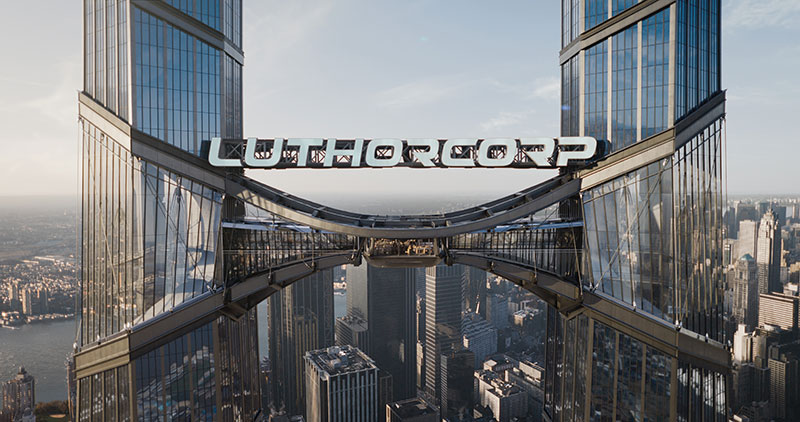
Luthorcorp Tower acted as a centrepiece both in the city skyline and in the story. Acting as a command centre for the scheming Lex Luthor and his team, its interior shots needed to show a constant view of Metropolis in its varying stages of disaster. Luthor’s control hub, at the top of the tower, becomes a flying escape ship, its design requiring it to blend in with the tower, physically and aesthetically. It was not to draw too much attention in the earlier part of the film.
The Daily Planet building was also built, a location from which we view the city's panic and evacuation from the advancing Rift destruction. The Daily Planet rooftop was a CG set extension to a practical set, featuring the iconic world globe.
Towards the end of the film, we had to implement a rift tear that began splitting the city in two. The rift was built from an ever-growing construct of bismuth, a metallic-like blocky substance. Complex simulations were undertaken to create an effect that had an organic growth to it, but was metal in nature. It would continue to grow and consume its surrounding environment, buildings, streetscapes, and the terrain. We had to ensure that the scale of the rift through the city was believable, both in extreme wide shots from above, as well as in much closer shots as Superman fought within the rift itself. Great care was taken in showing different buildings reacting to the rift, from outright destruction, falling into the rift, or neighbouring buildings falling against each other like dominoes.
Superman spent the movie going toe to toe with a lineup of dangerous villains. The Hammer of Boravia was his first opponent, a hulking metal figure that menaced citizens before defeating Superman in a sky-high battle and sending him crashing into the pavement below.
The Hammer of Boravia, for most shots, had to be a CG replacement, as his performance change required it, or the reconstruction of him, and/or the in-plate lighting had to be changed. It became more efficient and flexible to replace him wholesale in most shots. This required the asset build to match very closely to the plate, which became an excellent reference for us.
Superman also fought the Engineer, a soldier with robotic “Nanites” for blood who can control them at will. There were two main Nanite behaviours we created, first, the Nanites on the Engineer herself, granting her increased mobility and weapons. Second is when the Nanites were an ominous swarm that streamed up onto Superman.
The Engineer-controlled nanites forced their way into Superman’s eyes, nose and mouth, with Superman constantly struggling to resist the attack. The FX performance and interaction required it to read as a constant onslaught, with the nanites continuously being scraped and torn away. Despite this, Superman was ultimately overcome, completely covered and cocooned. In a later sequence, he’s able to purge the gooey metallic nanites from deep within his lungs.
Superman’s final and greatest opponent was Ultraman, a clone of Superman himself. Their fight scenes involved several long, complex takes full of dynamic camera movement and stunt jib work. The two characters often shared the screen at the same time, so we were completing multiple shots of face replacement / twinning work. Often, Superman and Ultraman were shot with David Corenswet in situ, in multiple takes, which gave us a great reference for the face replacement work. Either the plates were used for split screen work, for projection work or were used to help feed and build our trained model of David. Shots were often completed with a combination of these techniques.
Throughout these fights, with Hammer, Engineer, or Ultraman, Superman was often required to be replaced, adding to his performance, where we’d just retain his face from the shot plate, and the rest would be created using CG. This would be true for the Engineer and Ultraman too. Inevitably, Sim work was required, Superman needing suit, cape and hair sims, as he sped through the sky, fought his enemies, or posed dramatically. The directive was for the Sim work to be more based in reality, with only a small amount of art direction on some shots, enhancing Superman’s performance and prowess.
As much time as we spent creating environments, we also destroyed them. Effective use of environmental destruction was a great tool to aid the creative storytelling by showing the speed and power of the superheroes and villains as they fight. Crash landing into a baseball field in an explosion of grass and dirt, craters in concrete upon impacts and smashing against and through the bismuth-walled rift were some of the effects that our team developed to make the audience believe every hit. The destruction reaches a crescendo at the end of the movie as the rift opens up a black hole that begins to completely tear apart the surrounding environment.
The Rift destruction involved an extensive environment build, with a blend of both our real-world environment and the metallic bismuth blocky world. The real-world objects were important; they helped us define and understand the scale of the Rift, as the repeating bismuth block world became difficult to interpret and comprehend. This environment also included ongoing multiple simulations, collapsing tumbling destroyed buildings, continuous cascading earth and debris at numerous scales and coverage, and broken water pipe simulations, among others.
Within the rift itself, there were two “world gravities”. The rift had opened up another pocket dimension universe, whose gravity would impact upon our Earth’s gravitational pull. This played out within the Rift chasm, with our real-world destruction items, cars, buildings, debris, etc, falling down with the rift, yet also some Bismuth blocks would “fall up”. Some collisions would occur, and these conflicting dimensions would add to the visual complexity of the two worlds meeting. Ultimately, the pocket universe world reveals a black hole that rips apart the Rift and the surrounding environment, consuming both worlds and our anti-hero Ultraman.
CREW
Stephane Ceretti - Production VFX Supervisor
David Dally – ILM VFX Supervisor
Ilona Blyth – VFX Producer
Matt Middleton – CG Supervisor
Ben Tillmann – CG Supervisor
Stephen King – Animation Supervisor
Nicolas Caillier – Compositing Supervisor
Bryan Smeall – Compositing Supervisor
Murat Aysali – Paint and Roto Supervisor
Ian Dodman – Lighting Supervisor
Chris Ung – FX Supervisor
Nick Van Diem – Creature Supervisor
KiKi Teo – Texture Supervisor
Cao Ye – Generalist Supervisor
Stanley Wong – Model Lead
Marcus Bain – Layout Lead
Gillian Howe – Executive Producer