
Feature Film VFX
Wicked: For Good
Industrial Light & Magic
ILM were responsible for delivering over 570 shots for Wicked: For Good. These encompassed a wide range of work types that had to both expand upon existing work that was done for Wicked, but also required completely new environments and assets to be built. As with the first movie, key to the VFX was respecting existing material. This meant that passages from the books, the original 1939 movie, aspects of the stage production, and timing of the music all played a part in the work.
The movie opens on the construction of the iconic Yellow Brick Road. For this sequence ILM were tasked with creating CG enslaved bison, an almost complete replacement of the environment and sky, and digital doubles for Elphaba and the Ozian guards. The bison were a particular challenge for the simulation team. The animation had to drive a large and complex chain of simulated dependencies, from base skeleton, to muscle, fascia and fat layers, skin, long shaggy hair, harness (with both chains and timber sections) and then onward through connecting chains via a weighted yoke, to the bricklaying machine… and all multiplied by 4 individually animated bison. Some also carried baskets with simulated groups of yellow bricks through the scene.
For the song The Girl in the Bubble, multiple plates were seamlessly stitched together to form an extravagant 3m 18s oner which featured a number of invisible camera transitions through the various mirrors in Glinda’s apartment, partial CG replacements of the room and a full frame morph between takes.
The team built upon existing dev from previous movies to create the famous tornado which carries Dorothy’s house to Munchkinland. This required a full cloud simulation which considered temperature, pressure, gravity and buoyancy, and was art directed with custom made velocity fields which also formed the tornado funnel. These velocity fields were then used to simulate other elements, such as soil, rocks, debris and thousands of yellow bricks.
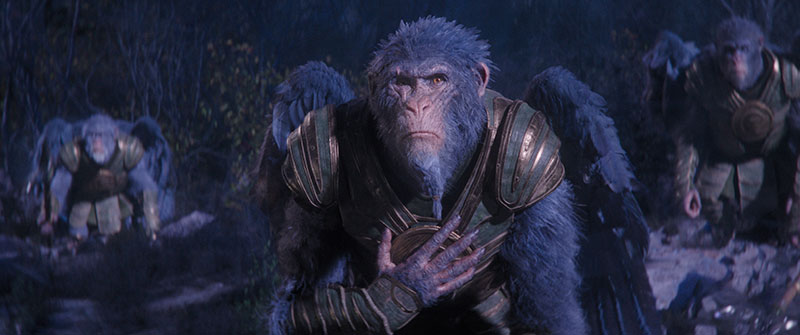
Many costumes were re-designed for the second movie, including multiple changes for Elphaba, and two completely new sets of armour for the flying monkeys, which were built in collaboration with Paul Tazewell (Costume Designer), the second of which was built modularly to allow for variety across the monkey crowd.
The No Good Deed sequence featured a fully CG castle and surrounding environment, a huge atmospheric dust sim, partial and fully digital Elphabas and the flying monkey army. The work done to develop the Grimmerie in Wicked was also built upon for the second movie to help suggest Elphaba’s proficiency with the book. The artistic direction of the peeling and unfurling of the pages meant that this scene had the largest and brightest Grimmerie spell, which also needed to tie into the amount of light that was used on set.
ILM also created entirely new views of Emerald City, a completely CG forest, turned the Wizard’s Throne Room and giant mechanical Wizard Head into a multicoloured disco, and to top it off, we also gave one of the flying monkeys Glinda’s pink jacket, that he stole from her in the first movie!
CREW
Pablo Helman - Production VFX Supervisor
Anthony Smith – ILM VFX Supervisor
Sandra Beerenbrock – VFX Producer
Nick Pitt-Owen – CG Supervisor
Mathieu Walsh – Associate Animation Supervisor
Julien Leveugle – Compositing Supervisor
Marco Chau – Creature Supervisor
Alex Halstead – FX Supervisor
Norberto Idiart Ritter – Generalist Supervisor
Nick Cross - Lighting Supervisor
Sarah Monaghan - Paint & Roto Supervisor
Moby Francis - Lead Modeler
James Lucas - Lead Texture Artist
Clemence Bellier - Lead Groom Artist
Kai Hsin Chin - Lead Compositor
Emmanuele Diotti - Lead Compositor
Alex Goodfellow - Lead Crowd Technical Director
Giorgio Pennisi - Lead Creature Technical Director
Julian Gregory - Layout Supervisor
Kacy McDonald – Executive Producer