

Feature Film Animation
Lilo & Stitch
Industrial Light & Magic
Lilo & Stitch (2025) directed by Dean Fleischer-Camp is a live-action reimagining of Disney’s 2002 animated classic, the wildly funny and touching story of a lonely Hawaiian girl and the fugitive alien who helps to mend her broken family.
Industrial Light & Magic (ILM) was the primary vendor on the film, with a team of nearly 200 digital artists, production and support crew working from ILM’s Sydney studio, completing 354 shots and 86 total assets over a period of 14 months.
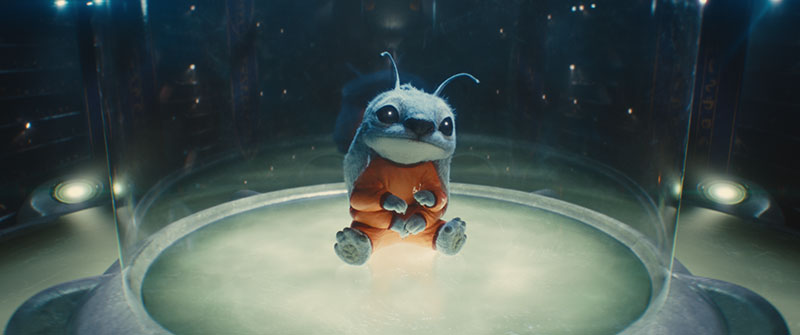
The work included the bulk of the shots in the full-CG opening sequence of the film featuring Stitch on trial in the Galactic Federation headquarters and subsequent escape in a stolen ship; Stitch meeting Lilo for the first time at the animal shelter showcasing a full-CG environment in the rafters where Stitch hides, along with many complex shots where Stitch physically interacts with Lilo; a recreation of the classic scene from the original movie where Lilo demonstrates to her sister Nani how Stitch can control the record player by opening and closing his mouth; and the climactic fight scene at Lilo’s house where the villainous Jumba tries to recapture Stitch resulting in the ultimate destruction of the house.
One of the biggest creative challenges the team faced was the design and execution of the opening sequence. Drawing inspiration from the original movie, it needed to evoke the style and tone that fans remembered, while updating to a more photo-realistic look in tune with the new live-action format.
Working from the ground up, the starting point was figuring out how to incorporate real-world elements into the design of the characters and environment that audiences could identify with and relate to, since the scene is set entirely in outer space.
With the characters, the solution was to draw cues from the shape language, tones and textures of how they were originally painted and then lean into and apply real-world animal characteristics and features; for example the guard escorting Stitch in the transport elevator with a head shaped like a hammerhead shark, or the cute pink alien, who wants to blow up the Earth, having a slight resemblance to an axolotl.
The environment design became a combination of retaining the original movie’s director Chris Sanders’ unique, rounded aesthetic, where there were no sharp edges and a bubbly toy-like feel, while working in metal, plastic, and other real-world hard surface textures to make it feel detailed and realistic. There was also a conscious effort made to walk the line of giving the lighting a mood consistent with the tone of the story, but not to go too dark, serious, and desaturated with it in order to maintain the sense of fun.
From an animation perspective, the scene featured a large number of background characters that needed to perform in different ways. In the Galactic Federation headquarters, art-directed Crowd simulations were employed for the aliens watching Stitch being sentenced to exile, and in the Control Room after Stitch has escaped, the Animation team created a number of hand-placed vignettes of the crew going about their daily tasks to fill out the shots and make the Galactic Federation feel like a living, breathing workplace.
The shots with Lilo physically interacting with Stitch were some of the most difficult to integrate, particularly in the animal shelter when they meet for the first time. A lot of effort went into the detail of when they hug, Stitch jumping on Lilo when he sits on her chest, and when she strokes his fur, with complex fur simulations and CG replacement of Lilo’s hands, arms, and clothing required to get the interactions to look seamless.
Bodily fluids and interaction with them were also a challenge across the film. Stitch drools in the Transport Elevator to distract the robot guards, he spits on glass windows in two separate scenes and rubs his nose in it, as well as leaving a snot trail from his nose on the glass in one particular shot. The FX team had their work cut out for them, getting the dynamics and realistic shading of the fluids to feel correct.
Creative iterations on the shots continued up until very close to the final delivery deadline, so on the technical side, automation processes were put in place wherever possible to help expedite the changes. On many shots, when an animator had done an update, the changes could be run through a previously established auto-simulation of Stitch’s muscles and fur, and on the compositing side, templates were set up for the different types of shots in the opening sequence that could be run and re-run quickly to get new iterations back to the filmmakers for approval.
CREW
Craig Hammack - Production Visual Effects Supervisor
Will Reichelt – VFX Supervisor
Thandiwe Philips – VFX Producer
Feargal Stewart – CG Supervisor
Christopher Marshall – Animation Supe (SYD)
Cody Gramstad - Art Director
Paul Braddock - Modelling Supervisor
Sebastian Ravagnani - Lighting Supervisor
Radost Ridlin - Compositing Supervisor
Scott Britton – Lead Animator (SYD)
Andy Finlayson – Lead Animator (SYD)